There is a particular moment in every customer's journey that marketers have spent decades trying to capture — the moment of intent. The instant when a person moves from passive awareness to active interest, from browsing to genuinely wanting something. For the better part of the last two decades, that moment has lived primarily in the search bar. A customer types a query, scans the results, clicks a link, lands on a page, and then — more often than not — disappears.
The page loaded. The intent was real. But somewhere between the search result and whatever the brand had prepared on the other side of the click, the connection broke.
Google Search to RCS Chat is built to fix exactly that break. By enabling customers to initiate a direct, rich, interactive conversation with a business straight from their Google search results — without visiting a website, without filling out a form, without waiting on hold — it transforms the search result from a signpost into a genuine starting point for a relationship. And in doing so, it redraws the map of what customer acquisition and engagement can look like in 2026.
The Problem With How Brands Have Been Reaching Customers
To appreciate why Google Search to RCS Chat matters, it helps to be honest about how broken the current model has become.
Digital advertising, which has served as the primary customer acquisition mechanism for most consumer-facing businesses over the past fifteen years, is in measurable decline as an effective channel. A significant proportion of internet users have become effectively unreachable through programmatic and display advertising — whether through ad blockers, platform privacy changes, or simple banner blindness accumulated over years of exposure. Of the ads that do reach someone, the overwhelming majority fail to generate the quality of attention required to meaningfully influence behaviour. The impression was served. The customer didn't notice.
The post-click experience on owned channels hasn't compensated for this erosion. Landing pages, however well-designed, are passive. They present information and wait. They have no ability to respond to the specific question a customer arrived with, no way to adapt to the customer's apparent level of interest or urgency, and no mechanism to keep the customer engaged once they navigate away. The bounce rate on most landing pages tells the story clearly — the majority of visitors who arrive leave without taking any meaningful action.
Meanwhile, customer expectations have shifted in a direction that makes all of this worse. Today's consumers have been conditioned by their best digital experiences — same-day delivery, instant messaging responses, personalised recommendations — to expect immediacy, relevance, and the ability to communicate on their own terms. A static landing page that requires them to fill in a form and wait for a callback is not just an inconvenience. It is a signal, however unintentional, that the brand hasn't thought carefully about their experience.
Against this backdrop, the logic of Search to Chat becomes clear. Customers are already searching. The intent is already there, at its highest point. The question is whether the brand can meet that intent with something better than a webpage.
What Google Search to RCS Chat Actually Is
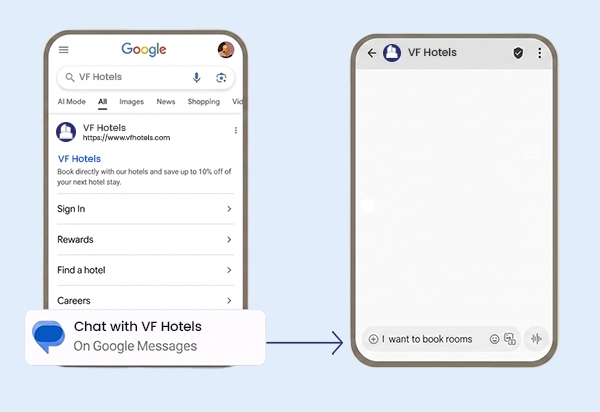
Google Search to RCS Chat is a capability that places a direct messaging entry point within Google Search results, allowing customers to initiate a real-time conversation with a business through the Google Messages app — the native messaging application on Android devices — at the exact moment they are actively looking for something related to that business.
The technology is powered by RCS — Rich Communication Services — which is the modern successor to SMS and the standard that enables rich media, interactive elements, verified sender profiles, and persistent conversation threads within native messaging applications. When a customer taps the chat option that appears in search results, they are not redirected to a third-party app, a website chat widget, or any external platform. They are taken directly into a conversation thread in the messaging app they already use, with a business whose identity has been verified, in an interface that supports images, carousels, quick reply buttons, payment flows, and every other interactive feature that RCS enables.
The customer does not need to download anything. They do not need to create an account or remember a password. The conversation is persistent — they can return to it hours or days later and pick up exactly where they left off. And the business, on the other end, can respond through AI-powered agents, structured conversation flows, or live human agents, depending on the nature of the interaction and the stage of the customer journey.
It is, in essence, the ability to have the right conversation at the right moment — and to make that conversation as rich, personalised, and actionable as the best digital experience the brand can offer.
Why the Moment of Search Is the Moment That Matters Most
There is a reason why search advertising has commanded premium pricing for as long as it has. Search captures intent in a way that almost no other channel can match. When someone searches for a product, a service, a brand name, or a problem they are trying to solve, they are not browsing passively. They are actively looking for something. That distinction — between passive exposure and active seeking — is the most important variable in predicting whether a customer interaction will lead to a meaningful outcome.
The challenge has always been that the gap between the search result and the business's response introduces friction that erodes that intent. Every additional step a customer must take after clicking a search result — loading a page, navigating a menu, finding a contact form, waiting for a response — represents an opportunity for their motivation to diminish. Intent decays with time and friction. The best possible outcome for any business is to meet the customer's intent at the moment it peaks, with something that enables immediate action.
Google Search to RCS Chat achieves exactly this. The conversation begins at the search result, before any friction has been introduced, at the point of maximum customer motivation. And because the conversation is interactive and immediate, the customer's intent is channelled directly into a productive exchange rather than dissipating across a sequence of impersonal touchpoints.
The practical consequence of this timing is significant. Customers who engage with a brand through a messaging interface at the moment of a relevant search query are substantially more likely to complete a purchase, book an appointment, or resolve a support issue than customers who click through to a landing page and navigate the conventional post-click experience. The intent is identical. The outcome differs because the channel respects and preserves that intent rather than gradually depleting it.
The Five Stages of a Search-to-Chat Customer Journey
Understanding how Google Search to RCS Chat works in practice requires tracing the customer journey from discovery through conversion and beyond.
How Different Industries Are Using Search to Chat
The versatility of Google Search to RCS Chat as a customer engagement mechanism is one of its most practically significant characteristics. Because the conversation layer can be customised for any use case, the same underlying capability manifests very differently across industries.
The Structural Advantage Over Traditional Advertising and Landing Pages
It is worth being explicit about what makes the Search to Chat model structurally superior to the conventional search advertising and landing page approach, because the difference is not merely one of execution quality — it is architectural.
Traditional search advertising places a brand in front of an interested customer and then asks that customer to do a significant amount of work to complete an interaction. Click, wait for a page to load, navigate to the right section, find contact information, fill in a form, wait for a response. Each step is a chance for the customer's motivation to drop below the threshold required for action.
Search to Chat removes almost all of these steps. The customer's action — tapping to begin a conversation — immediately produces a response. There is no latency, no navigation, no uncertainty about whether their message has been received. The response is immediate, personalised to their query, and capable of completing most interactions without any further effort on the customer's part. The structural advantage is not incremental. It is the difference between a system designed around the brand's convenience and one designed around the customer's.
There is also a data dimension that the conventional model cannot match. A landing page interaction tells a brand relatively little about the customer — which page they visited, how long they stayed, whether they converted. A conversation tells the brand everything — what the customer asked, what options they considered, what concerns they raised, what ultimately drove their decision. This conversational data is both more granular and more meaningful than any metric that web analytics can generate, and it compounds in value over time as each subsequent interaction adds context to the customer's profile.
What This Means for the Future of Customer Acquisition
The emergence of Google Search to RCS Chat as a genuine customer engagement channel reflects something larger than a product feature — it reflects a fundamental shift in what the relationship between a brand and a customer can look like at the point of discovery.
For decades, acquisition was a broadcast model. Brands spoke. Customers received. The best a brand could hope for was that enough of the right people received the message at a moment when they were ready to act, and that the subsequent experience was good enough to convert passive receipt into active purchase.
The conversational model inverts this. It starts with the customer's intent rather than the brand's message. It responds rather than broadcasts. It builds context across interactions rather than resetting with every visit. And it creates a relationship channel that persists and deepens over time rather than closing after a transaction.
Brands that understand this shift early — and build the conversational infrastructure to support it — are not just improving their conversion rates. They are establishing a fundamentally different kind of relationship with their customers, one grounded in genuine responsiveness rather than sophisticated broadcasting. In a marketplace where customer attention is the scarcest resource and trust the most valuable currency, that difference is not tactical. It is strategic.
The future of customer engagement is not louder advertising or more sophisticated targeting. It is better conversations, starting at the right moment, in the right channel, with the right message. Google Search to RCS Chat makes all three possible simultaneously — and for brands willing to embrace it, the results speak for themselves.
Connect with us to know more about the RCS Business Messaging solutions!