What if a customer never had to leave a conversation to complete their journey?
Consider the last time a user clicked on a brand message. More often than not, they were redirected to a browser, waited for a page to load, switched applications, lost context, and in many cases, abandoned the task altogether.
Now imagine a different experience.
A user taps a button inside an RCS message, and the brand’s website opens directly within the conversation itself—fast, smooth, and without breaking the flow.
This is the power of RCS Webview.
It is a capability that quietly transforms RCS from a messaging channel into an experience layer for digital journeys. Let us explore why this matters and how it fundamentally changes customer engagement.
What Is RCS Webview?
RCS Webview allows brands to open web pages directly inside the RCS conversation interface instead of redirecting users to an external browser or application.
In simple terms, it enables customers to browse, fill forms, make payments, and complete actions without leaving the chat.
The conversation becomes the container for the entire journey. Not just communication, but execution.
Why RCS Webview Matters
At first glance, Webview may appear to be a minor user experience enhancement. In reality, it addresses one of the most persistent problems in digital engagement: loss of context. Each time a user is forced out of a messaging interface, the likelihood of distraction and drop-off increases, while conversion rates decline.
RCS Webview solves this by keeping users within the conversation, where trust is already established, attention is focused, and intent is high. As a result, RCS evolves from a messaging channel into a transactional, navigational, and conversion-oriented platform.
From Message to Marketplace: How Webview Changes Customer Behavior
Traditional journeys typically follow this pattern:
With Webview, the journey becomes:
The brand retains the user, and the user retains context. This shift has significant implications for how digital journeys are designed and optimized.
Industry Use Cases for RCS Webview
E-commerce and D2C: Bringing the Store Into the Conversation
With RCS Webview, an e-commerce brand can allow customers to browse product catalogs, filter by preferences, add items to cart, and complete checkout directly within the chat.
This eliminates app dependency, reduces friction caused by redirections, and minimizes drop-offs during the purchase journey.
For direct-to-consumer brands, messaging is no longer limited to promotions—it becomes a true sales channel.
Travel and Aviation: Completing Journeys Without Breaking Flow
Airlines can use Webview to enable seat selection, web check-in, baggage add-ons, meal preferences, and boarding pass access directly from an RCS message.
Instead of requiring users to log into apps or websites, the entire process can be completed in one continuous flow.
In this context, RCS Webview transforms messaging into an operational channel rather than just a notification layer.
Banking and Financial Services: Secure, Frictionless Actions
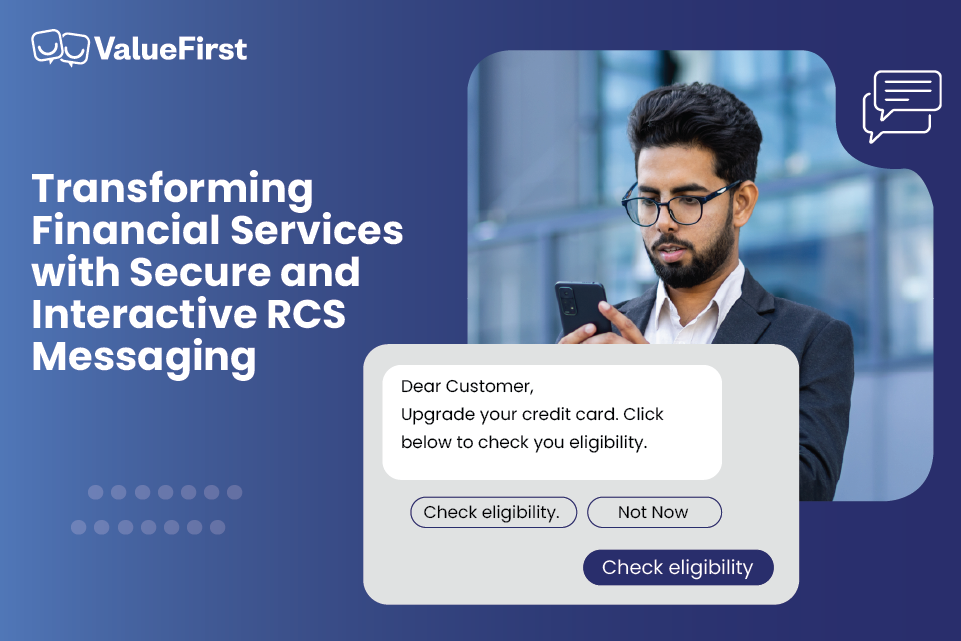
Banks and fintech companies can leverage Webview for loan applications, KYC uploads, EMI calculators, credit card onboarding, and insurance purchases.
Because the experience remains embedded within the RCS conversation, users feel they are interacting directly with the institution, not being redirected to an unfamiliar environment.
This continuity builds trust, improves completion rates, and enhances overall customer confidence.
Automobile: From Discovery to Booking Without an App
Automotive brands can enable variant comparisons, EMI calculations, dealer discovery, test drive bookings, and service appointments using Webview within RCS.
This allows users to move from interest to action without installing an application or navigating multiple platforms.
For users experiencing app fatigue, this approach offers a streamlined alternative.
Education and EdTech: Admissions Without Friction
Educational institutions can use Webview to support course discovery, application submissions, fee payments, document uploads, and demo class bookings.
When launched from RCS campaigns or search-led entry points, the entire admissions journey becomes conversational, significantly reducing abandoned forms and incomplete applications.
Healthcare: Action Without Anxiety
Hospitals and diagnostic centers can embed appointment booking, doctor availability, lab test selection, payments, and report viewing within Webview.
By minimizing platform switching, Webview reduces cognitive load for patients and improves accessibility during moments of stress.
Here, Webview is not merely a UX enhancement, it is empathy delivered through design.
Real Estate: Turning Interest Into Action
Real estate brands can showcase property listings, floor plans, virtual tours, lead forms, and site visit bookings directly within RCS conversations.
This allows casual interest to convert into qualified engagement without losing momentum through redirections.
Choose the Right Experience with Three Display Modes
RCS Webview is not a one-size-fits-all experience. Depending on the use case, brands can choose how prominently the web content appears within the conversation.
RCS Webview supports three display modes, allowing businesses to balance immersion, context, and ease of navigation.

1. Full Webview Mode
In Full mode, the web page opens in a full-screen view within the RCS interface.
Best suited for:
2. Half Webview Mode
In Half mode, the web page opens in a partial screen, while the conversation remains visible.
Best suited for:
3. Tall Webview Mode
In Tall mode, the web page opens in an extended vertical view that preserves conversational continuity while offering more space than a compact view.
Best suited for:
Why RCS Webview Is a Strategic Advantage
RCS Webview addresses three major business challenges:
In a landscape where users resist installing new applications, RCS Webview effectively turns messaging into the app.
The Bigger Picture: RCS as a Business Platform
RCS began as an enhancement to SMS, introducing rich media and interactivity. With Webview, it evolves into a full-stack digital experience channel.
Marketing, sales, customer experience, and support converge within a single interface.
Messaging is no longer a peripheral function. It becomes a core business platform.
Final Thoughts
The future of customer engagement is not defined by better conversations alone. It is defined by enabling customers to take meaningful action without leaving the conversation.
Brands that recognize this early will not just communicate more effectively—they will sell, serve, and scale more efficiently.