What if discovering a brand and talking to it became the same moment? You search for something on Google. A bank. A flight. A nearby salon. A course.
Until now, that journey usually looked like this: Search → Website → Form / Call → Wait → Finally talk to someone.
But what if instead, it became: Search → Tap “Message” → Start chatting instantly
Welcome to the era of Google Search–Led RCS — where discovery and conversation merge into a single, seamless experience. And quietly, this might be one of the most powerful accelerators for conversational commerce we’ve seen so far.
Let’s dive in.
The Shift: From Clicking Links to Starting Conversations
Google has always been about helping users find businesses. RCS is about helping users talk to businesses. Now, these two worlds are colliding.
With Google Search–Led RCS, when users search for a business on Google, they see a Message icon right next to the usual Call and Website buttons. One tap, and an RCS chat opens directly with the brand — no app downloads, no website hopping, no IVR menus.
This transforms a passive discovery moment into an active engagement moment.
And that changes everything.
Why This Feature Matters (More Than It Seems)
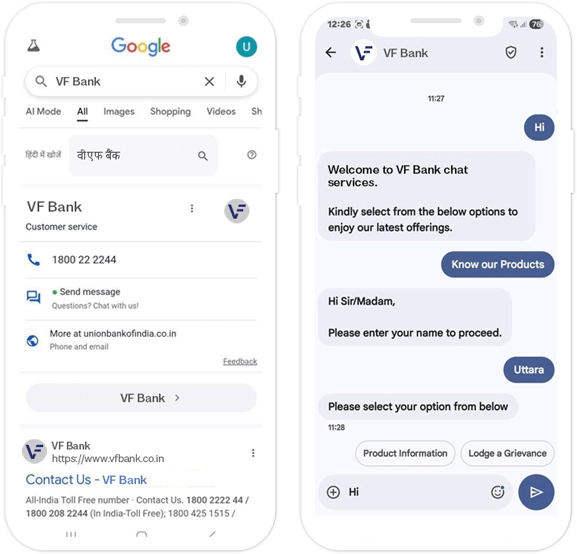
On the surface, it looks like just another CTA button. But in reality, it unlocks three powerful shifts:
1. Discovery Becomes Conversational
Earlier, search was about finding information. Now, search becomes the start of a relationship. Instead of reading about a product, users can:
2. High-Intent Traffic Finally Meets Low Friction
A user searching for “best credit card for travel” or “2 BHK in Gurgaon” already has intent. RCS removes the friction between that intent and action by replacing:
3. RCS Becomes a Full-Funnel Channel
Not just for notifications. Not just for support. But for:
All from one entry point.
Designing a Winning Google-Led RCS Experience
This feature is powerful — but only if brands design it right. A high-performing RCS flow must have:
Not “How can I help you?” But:
Let bots handle:
Humans handle:
Why Google-Led RCS is a Game Changer for Brands
This feature quietly solves three massive challenges brands face today:
Now: Traffic → Conversation → Conversion
Now: One channel from discovery to support
Now: Organic search becomes a direct engagement channel
Google-led RCS turns owned search presence into an owned conversational asset.
The Bigger Picture: Where This Takes RCS. RCS is no longer just: “SMS with images” or “better notifications”. With features like Google-led entry points, RCS becomes: a business operating layer for customer communication.
From discovery → to decision → to retention.
Final Thoughts: The Future is Not Clicks, It’s Conversations
We’re entering a world where customers don’t want to:
They want to simply: Search → Talk → Decide. And Google-led RCS is quietly making that possible.
For brands, the question is no longer: “Should we use RCS?”
It’s now: “How fast can we redesign our customer journeys for conversation-first discovery?”
Because the future of engagement is not built on pages. It’s built on conversations.